
MOTAT
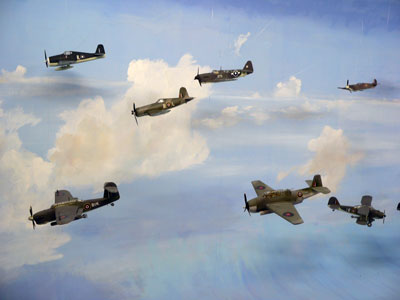
in Western Springs, Auckland. This is, of course, a diorama.
Not only was I revisiting my love of aeroplanes,
but I was also returning to some of my persistent themes.
The first is the question of scale. Often with my work it is a little difficult
to work out just how big the subject really is.
The second is the theme of whether or not the subject is real, or fake.
The third theme that I recognise is the way in which I seem to be interested in
the spaces between obects within the frame. In fact sometimes the spaces seem
to be one of the main reasons for taking the photo in the first place.
I don’t deliberately set out to take photo that illustrate these themes, they just
seem to pop up.
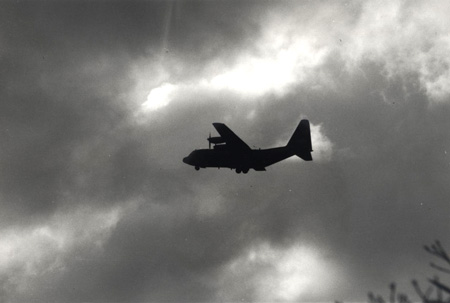
and right off the end of Whenuapai airfield, an airforce base.
These planes, and assorted others, regularly flew past my home.
Herald Island is named after HMS Herald, the ship which,in 1840, took the
Treaty around NZ as signatures were collected. During the few days in Auckand it
explored the upper reaches of the harbour and circumnavigated what was to become known
as Herald Island. There is no known Maori name, although in later years it also became known as Pine Island.
When married to Kendrick Smithyman, who was teaching in the tiny sole charge school,
Mary Stanley wrote a poem which went ‘cut off by tides, we here are islanded.’

 What are your influences?
I’m often asked this by students, and sometimes I explain that one of the biggest is that was brought up in a very rural environment. Animals of all descriptions, both wild, and domesticated were part of my everyday life.
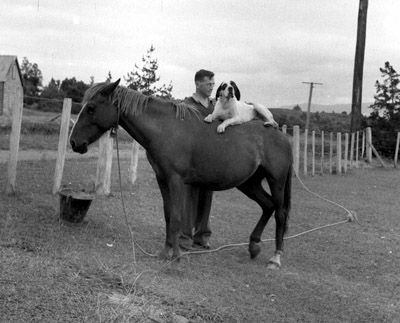
This is a photo taken at Taheke, in the Hokianga, where some of my most formative years were spent. This is my father with our dog Whisky, and one of our horses, I’m not sure which one, perhaps Ginger, or Five Bob, the latter so named because he was a wild horse rounded up and sold by local Maori for that sum. Taheke was a predominantly Maori area and my life was very affected by my contact with them.
Our horses were tamed and taught by my father to perform tricks. Everything was gently done and I never saw any force used.
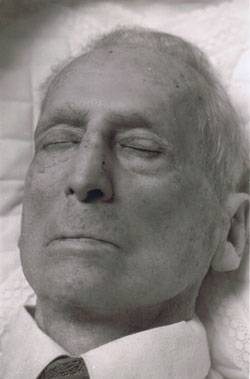 A photo of my father, taken a few hours after his death.
At my request, the undertaker allowed me to help him prepare the body
for cremation. Born in Gisborne in 1904 he died in Auckland at the age of 92.
I’m sorry that I didn’t take more care with organising his top lip. It’s come out looking
a bit lopsided, and I could see that at the time but somehow I lost my nerve. I should
have been more patient.
Overall though, helping the undertaker in this way was a positive thing to do, healthy
in many ways, a natural conclusion.
I’ve been thinking about this event a lot lately because I’m writing down as many of my early
memories as possible, and naturally my father is a frequent player in many of these.


Trains.
The wave photograph below was taken a few metres from where my parents used to live, here in New Plymouth, before I was born, unfortunately. My father was a keen photographer, and the family have many of his photos in our possession.
What surprises me is the similarity between some of his photos and mine. Here are a couple of examples.
The left hand image is taken at the port. The building in the centre is the Breakwater Hotel where my parents lived. Last year the Breakwater closed down forever.