Innovative, cutting edge.

Sitting on my desk for the last couple of weeks is an invitation from the Govett-Brewster Art Gallery,
here in New Plymouth.

It is an invitation from three of the curators there to come to an evening ‘highlighting some of the world’s most recent biennales showcasing the freshest and most innovative contemporary art from around the world.’ ‘What’s hot on the contemporary arts scene?’ it says in big black letters across the top. ‘Find out what is cutting edge on the international art circuit’.

All three curators had been overseas recently, and collectively, they visited six different Biennales.

As it happened the evening clashed with my Japanese class and I was unable to attend but nevertheless it has concerned me because I don’t know whether I can make work that is innovative, or cutting edge, yet clearly that is what they are looking for. Does work have to be innovative or cutting edge to be good I ask myself. I feel the pressure.

The very use of the word contemporary art seems to have lost its original meaning of: existing or occurring at the present time. ‘The word has come to mean modern, up to date, fashionable…’ The word contemporary confers authority and style’. (Peter Timms).

‘Contemporary art remains obsessed with the idea of innovation…Innovation is an adjective so vital to the perpetuation of the art market that it has taken on an almost magical aura’. …Curators use ‘innovation’ and ‘innovative’ to frighten people’ (Peter Timms again)

But there is another way in which the invitation worries me. The three curators are clearly using Biennale as a major source of ideas for exhibitions yet Biennale generally need large showy art, often in installation form. Yet my work lately has become rather tiny, I’m worried that I will not have a chance of being included in shows that favour installations. The influence of Biennale might be a problem for artists who choose to work in a quieter more contemplative way, and on a smaller scale. There even appears to be a Biennale look. With over fifty Biennale in the world now, it may be that they are no longer sampling what is taking place, but shaping it.
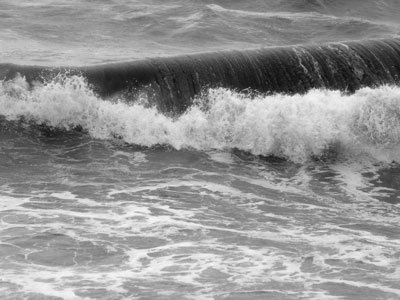
On Saturday the weather here in New Plymouth was wild,
with big seas crashing onto the shore. I went
out onto the breakwater as I often do, and could not help
wondering if in the waves, somewhere, there was a photo. This
is not it, but it does encourage me to return for another attempt
next time that the weather is suitable.

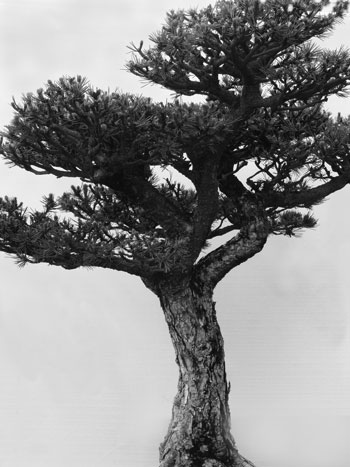
As I’ve written below, I’ve been looking closely at bonsai for some time now.
Yesterday I revisited a collection here in New Plymouth with the express purpose
of photographing this 50 yr old Japanese Pine.

I think that this image is about as close as I am going to get, so now
I’m going to print up an edition of it. Most years recently I have put out a
Christmas photo so this could be it. It will be small, not much bigger than what you see on your screen, and as inexpensive as I can economically make it.


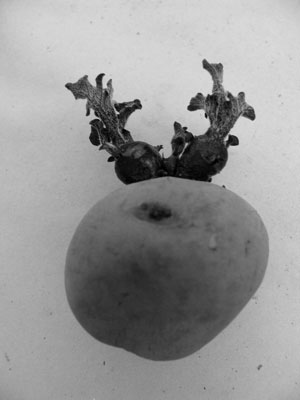
Two little sketches from this week. The bottom one is a close up of a potato that I am sprouting
along with several others.
So far I have not got around to planting them on the garden, partly because I’ve been too interested in them as they are.
So far I haven’t

planted them in the garden, partly because I’ve been too interested in them
as they are.

The top photo, I have tried a couple of times. It’s a little lamb that I bought at the Salvation Army store. This photo is still not right, for some reason slightly out of focus, but I will make another attempt. The lamb is floating in a river, hence the dark stone shapes. floating in a river, hence the dark stone shapes.

Bonsai


Bonsai, or at least the bonsai look, has caught my attention for some years now.

About 5 years ago a took this photo of this Rata, which had, in view of its extreme age and tortured appearance, acquired something of what I would call the bonsai look.

Recently I was invited to see one of NZ’s best collections of bonsai, a collection that unbeknown to me, was all this time, only a couple of kilometres away. I’ve seen a tree there, a Japanese Pine, about 50 years old, that I am going to return to, to photograph. It had very much this rata form.

Dear visitor, after many years of using the same software to
maintain my site, I have switched. Now I am using one
that is much simpler. Of course there is a lot to learn,
and it will be a little while before I can become fluent with it.

One advantage is that it can be maintained from any computer,
not just one that is carrying the appropriate software.