Graves at Midhurst


This cemetery at Midhurst in Taranaki is one that
I have discovered recently. If you are driving from
New Plymouth to Wanganui you will go through Midhurst.
 
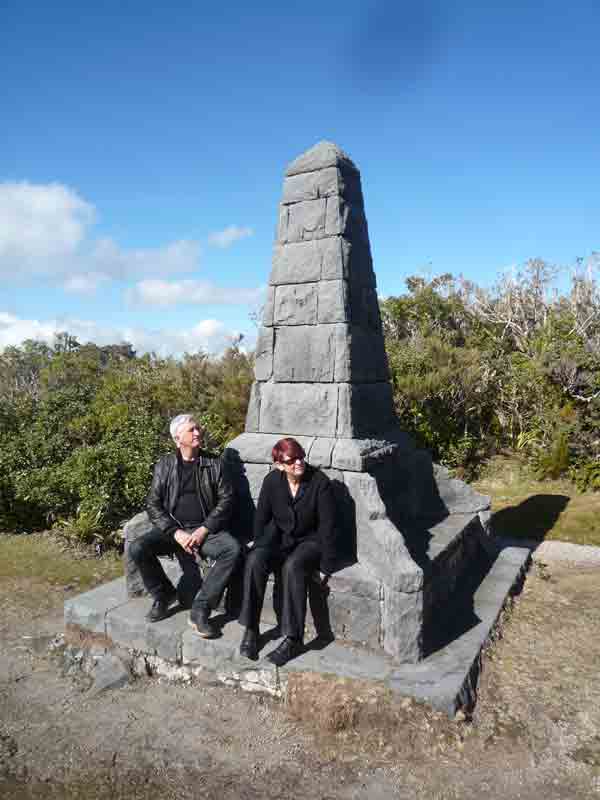
I don’t often photograph in cemeteries but
yesterday, with a biting south easterly and chilly rain
setting the mood, I decided to give it a try.
 

The Wave


Here is a photo that I took yesterday.
Living in a coastal town I have plenty
of opportunity to look at waves
but I don’t often feel tempted to take
a photo.
 
There is a peacefulness to this
particular image that appeals
to me.
 

Laurence Aberhart


New Zealand photographer Laurence Aberhart
is currently working in Taranaki and I am having
the pleasure of escorting him to some of my favourite
sites in the region.
 
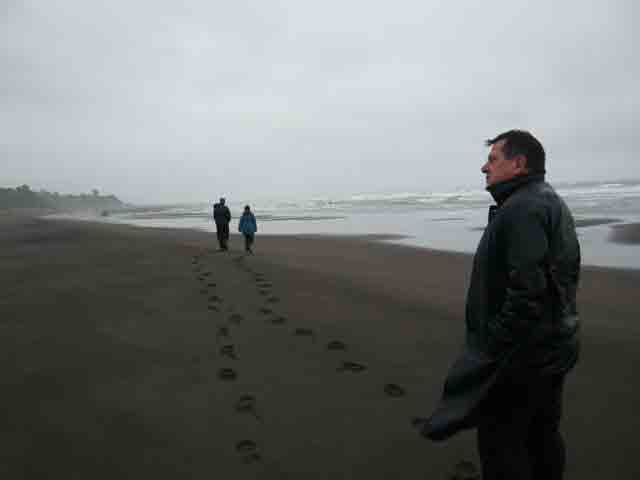
Here he is on the banks of the Waiwakaiho, one of many rivers which
runs off the mountain and down to the sea.
 
The camera, a Korona, is over 100 years of age.
 
Below is a photo that I took from the same position.
While not a keeper, it does amuse me.
What the image was that Laurence was seeking I have not
yet seen.


The Aesthetics of Dispersal 2


The aesthetics of dispersal is phrase that was coined by photography writer
Peter Ireland, to describe a common theme of mine.
 
It is very true that
images such as the one above
appear at regular intervals and seem to have
done so throughout most of my career.
 
These images contain a range of subjects,
in this case it is sheep. Yet it seems that it
is not the sheep that I am particularly
interested in but the spaces in between them
and the way that they have arranged themselves
over the hillside.
 
I have written about this subject in a previous post.
 

Pine


In New Plymouth there is a large park area
in the central city. It is made up of two
parks that abut each other. One is called
Pukekura and the other is called Brooklands.
 
Brooklands is well known for being the
venue of WOMAD and many other events.
 
However, like Pukekura, it has a number
of very mature trees. This pine is an example.
Radiata I think, there are several of them
and I often try to photograph them because
they are some of the most impressive examples
that I have ever seen.
 
This image doesn’t really give you an idea of the scale,
however, I will continue to work on them.


Mixed Media


Here are two photos, both a couple of years
old but they have something in common.
 
The top one, I would like
to see made into a tapestry. I have been looking
for a suitable photo for a long time, but this
is the first that I feel is close to what I need.
It has, for example, flat planes of
colour, anything with shading is too dificult.
 
As a boy I used to do quite a bit of needlework.
My mother encouraged me, in our family
it wasn’t seen as sissy at all.
 
Even in recent years I’ve had several
goes at taking it up. I think I give up
on that career now though. Someone
once described my stitches as tormented
and they were right. I’d rather find
a professional to do it for me now.
 
The photo of the stairs I would like to see
turned into a thousand piece jigsaw. Again,
it is the only photo that I have ever taken that
I’ve felt this way about.
 

Methanex at Motunui


In the previous post I referred to an
exhibition catalogue of my work
called The Left Hand Raised.
The photo above was included in that
exhibition. It was taken at the Methanex
plant at Motunui, a few kilometres north
of New Plymouth.
The plant converts natural gas into
methanol, almost all of which is exported
to countries such as China, Japan, and Korea.
Building it was one of the Think Big projects
from the time of the Muldoon government.
It remains one of the biggest engineering projects ever
undertaken in New Zealand.
When construction was finished, Methanex
gave this massive model to a museum here.
The model was not built just for fun
but as a visual guide to assist in the
construction.
While I can see what attracted me
to taking the photos below, I
am letting them pass as they
just don’t quite make it.


The Left Hand Raised. Photographs 1995-2001


A post or two ago I showed a recent
book that had been published about
my work. I also gave instructions
on how it could be purchased
from Parsons Bookshop in Auckland.
 
Here is another book, a small one this
time. It was the catalogue for
an exhibition that I had called
The Left Hand Raised.
The exhibition was here
in New Plymouth at the
Govett-Brewster Art Gallery.
 
The photos in the book are all in black
and white, at that stage I was only
beginning to work in colour.
 
There are 24 photos, one per page,
and I have written notes on each
of them.
 
This book too can be purchased from Parsons.
It is $13, something like that.
 
The photo on the cover is called Isabella
which was the name of the doll.

Watch Your Language: Art and Photography.


This is quite a difficult post to put together because
I’m writing about something that I sense is
wrong, but am not sure if I can put it into
words.
 
Being a photographer I often notice the phrase: Art and Photography.
I’ve heard it twice in the last
week on National Radio.
 
There is something
about this phrase that makes me wince.
 
I feel that it is possible that if deconstructed it
could be found to contain some residual prejudice against
photography as a medium, after all, one does not hear:
Art and Painting.
Or: Art and Sculpture.
 
There is a hierarchy in the media used by artists in making
their work.
Until recently anyway, Paint has been King.
Centuries of this being so seems to have hardwired the concept into people’s brains.
 
A medium such as Printmaking, for example, would be much further down their hierarchy. I mention this medium because I like
woodcuts and linocuts, although my impression is
that these two have almost disappeared at present.
 
The idea that a serious artist could choose a camera rather than
a brush, is one, which for many, seems to
take a lot of swallowing.
 
I don’t believe in the idea that any one medium is
inherently superior to another of course. I don’t think
that’s how art works.
 
It’s quite common for me to be in a conversation with someone
about my work, even a client, and they are repeatedly calling my
photographs paintings. I never say anything because I don’t want to
embarrass them and also because I’m quite fascinated, but I can see the process.
They are feeling that this object in front of them is considered art so it just
can’t be a photograph, it must be a painting, that’s how deep the
indoctrination goes.
 

A Letter For Students.


Dear students (and teachers),
I have a problem at present. I’m receiving
numerous requests from students seeking
help with their photographic assignments.
In the week before last I received 5, including 2 from Australia.
 
The assignments are often lengthy and involve
asking me a number of complex questions
about some aspect of my work,
or life. Sometimes just reading them
feels like homework.
 
Anyway, I’d like
to be helpful so I’m making a suggestion
that students seek out a book that was
published last year.
Ask your teacher to buy it for the
department, perhaps.
It is full of information
of the kind that I am often asked for,
biographical for example.
It can be ordered from Parsons in Auckland
and delivered to you in 2 or 3 days.
It costs $49.95, freight will be a bit extra.
books@parsons.co.nz
+64 9 3031557

And I would suggest using a search engine
such as Google. Type in Peter Peryer and
a mountain of information comes up, images included.
Remember to refine your search by writing,
for example “Peter Peryer biography”.
Also, I do have this online journal, of which this
post is number 736. In this blog I show and talk
about my work from a variety of angles.